The short answer
Start earlier than BFCM week, and discount smarter rather than deeper. For Black Friday 2026 (27 November): run a no-discount warm-up through early November, open early access for VIPs and subscribers around 12 to 14 November, launch publicly in the week of 16 November (waiting for BFCM week itself cedes wallet share consumers now spend early), escalate into the Black Friday weekend, run a distinct Cyber Monday offer on 30 November, and extend quietly into 1 and 2 December while competitors go silent. Send to your full, freshly-cleaned list on the big moments and taper follow-ups to engaged segments, letting engagement signals govern volume rather than a fixed cap. Keep the hero offer simple and competitive; gate access and segment-level depth, not the public offer. This playbook comes from an agency that runs BFCM for DTC brands, not from an email platform with a stake in your send volume.
Why does most Black Friday email advice fail DTC brands?
Because almost all of it is written by email platforms, and an email platform cannot give you the advice that actually decides BFCM outcomes: how to construct an offer that stays competitive without giving away the margin, and how to earn the right to send at peak volume without landing in spam. Their revenue scales with your sends and their case studies celebrate your discounts. When we audited the pages ranking for Black Friday email advice, every single one was commercially owned by a tool vendor, roughly seventy example emails were showcased across them, and about five carried any performance number at all. The advice layer for the biggest email weekend of the year is screenshots plus adjectives plus “use our platform”.
So this guide takes the agency frame instead. Everboost runs BFCM email and SMS programmes for DTC brands, and the pattern across our client results is consistent: the brands that win BFCM prepare earliest, architect their generosity, and send aggressively because they have earned the deliverability to do it. Not “send less”: earn the right to send more. The most extreme proof point in our own book: retention programmes we run have delivered 13.68x and 16.6x returns on Black Friday sends that were not emails at all but direct mail to lapsed buyers email could no longer reach, on code-gated offers rather than sitewide markdowns. Preparation, architecture and channel judgment beat depth.
For scale context: Shopify merchants alone did $14.6 billion over BFCM 2025, up 27% year on year, and Klaviyo reports 15,000+ brands setting their highest-ever sales day during the window. The demand shows up either way. Your margin either survives it or it does not.
When should you send Black Friday emails in 2026?
Earlier than the week of. This is where honest advice has changed in the last few years, so the trend first: Black Friday was a Friday, then a weekend, then a week, and now for many brands a month. Consumers have adjusted; a meaningful share of BFCM budgets is spent by mid-November, so a brand that waits for BFCM week itself arrives after wallets are lighter. But the creep is self-limiting, and worth being honest about: a list that has seen discounts since 1 November is numb by the 27th, practitioners who pushed earliest in 2025 reported diminishing returns, and the cultural peak (Black Friday through Cyber Monday, when most shoppers still actually buy) does not move just because your calendar did. Capitalise on the creep; do not lead it. And never starve your best offer away from the peak window in the excitement of launching early.
The 2026 calendar we build client plans around. Black Friday is Friday 27 November; Thanksgiving the 26th; Cyber Monday the 30th:
| Window | What sends | To whom |
|---|---|---|
| Late September to mid October | Nothing promotional. List cleaning, deliverability repair, authentication, cadence consistency | - |
| Late October to 8 November | List-building pushes, early-access signup (popup, click-through waiting list, reply-to-join email), preference capture. No discounts: warm-up value content, plain-text heavy | Engaged, widening |
| 9-13 November | Teaser: the schedule, not the full offer; early access final call | Engaged + VIP |
| ~12-14 November | Early access opens for VIPs, subscribers and the early-access list: the same offer the public will get, earlier, never weaker | VIP/subscriber/waiting list |
| Week of 16 November | Public launch: offer stated plainly, full prepared list on launch day, engaged-only follow-ups | Full list, then engaged |
| 19-25 November | Sustain: mid-sale layers (gift-with-purchase days, short flashes, segment offers), one send most days | Engaged + responders |
| Thanksgiving, 26 November | Warm, low-pressure send | Engaged |
| Black Friday, 27 November | Escalation or hero peak: morning launch, evening reminder, cascade structure for extra sends | Full list via cascade |
| 28-29 November | One to two sends per day, offer rotated or reframed, never repeated | Engaged + weekend engagers |
| Cyber Monday, 30 November | Distinct, restructured CM offer morning; genuine last-chance evening | Full list, then engaged |
| 1-2 December | Quiet extension while competitors go silent; strongest offer reserved for engaged never-purchasers | Engaged non-buyers |
| From ~4 December | Gifting pivot (see the post-BFCM section) | Engaged |
Three notes on that table. First, the start date is a variable, not a rule: work backwards from your revenue goal, and know that high-AOV, long-consideration products can justify going earlier because their buyers deliberate; impulse-priced products cannot. Second, the pre-season freeze matters: stop discounting from early autumn, because a list that saw a sale in October has no urgency left for November. Third, the back-end extension (1-2 December) is quietly one of the highest-leverage plays in the calendar precisely because competitors stop sending on Monday night; brands running it report outsized results, and the sharpest version reserves the strongest offer of the whole sale for engaged profiles who never purchased. One warning: this works because it is rare. Extend every promotion you run and your deadlines stop meaning anything; reserve the extension play for the one or two marquee events of the year.
How many Black Friday emails should you send, and to whom?
The wrong question is “what number”; the right question is “what do my signals say”. The framework we run:
Go wide on the moments, taper on the follow-ups. If you have done the preparation (the October clean, the cadence ramp, the suppressions below), your launch, Black Friday and Cyber Monday sends can and should go to essentially your full list: BFCM is the one window where even quiet subscribers buy, and the announcement sends are where the revenue concentrates. Follow-ups, reminders and mid-sale layers then taper back to engaged segments to protect deliverability between the big moments. Three mechanics from well-run programmes make the wide sends safer: send to your engaged segment first and the full list second on the same day, so positive signals land before the big blast; alternate broad and narrow across the sale rather than hammering the full list daily; and on multi-send days, cascade downwards, each later send going to a smaller, hotter segment excluding recent openers and purchasers, so your open rates hold flat even as volume climbs.
Let engagement signals govern the ramp. Watch opens, clicks, unsubscribes and spam complaints daily through the window. While positive signals hold and negatives stay quiet, keep the volume coming, because every brand in your customer’s inbox is ramping and the quiet sender gets drowned out; this is the one period where competing on volume is not optional. The moment negative signals spike, you have found your point of diminishing returns: pull back a step. Two rules keep the ramp safe: never double your send volume overnight (the brands that go from two sends a week to two a day on 20 November are the ones ISPs flag, which is why cadence consistency through early November is itself deliverability prep), and give every send a distinct job so volume reads as a campaign, not a repeat.
Run the exclusions like a discipline. Out of every sale send: purchasers in the last 48 to 72 hours (nobody wants a discount email for the thing they just bought), anyone with two or more purchases since the sale started (reintroduce them for the final days), hard bounces, repeat soft-bouncers, anyone who has ever marked you as spam, and known spam traps. These are permanent suppressions, not campaign filters.
Clean before, and after. The pre-BFCM clean is part of the preparation: profiles that have received many sends with no clicks and no site activity are not going to convert in November, and removing them is exactly what makes the full-list moments safe. Then clean again after the sale, because even a well-run BFCM leaves scar tissue: fresh bounces, complaints and a cohort of deal-takers who will never engage again.
What should your offer architecture look like?
This is the section the ESP guides do not write, and the honest version is more nuanced than “never run a sitewide sale”. Across the practitioners and datasets we reviewed for this guide, simple hero offers consistently beat clever complicated ones, and moderate depth frequently outperforms maximal depth; several of the best-performing programmes we audited ran flat sitewide constructions. The mistake is not sitewide; the mistake is sitewide by default, with no architecture around it. The framework:
1. The hero offer: simple and competitive. One offer a customer understands in a second, at a depth that survives comparison shopping, because your list will be holding competitor offers all weekend and going too shallow hands them a reason to defect. If a customer has to do arithmetic, you have already lost them. “Up to X%” anchoring (a headline number carried by selected SKUs, with demand-priced depth underneath) buys headline impact without flat margin across the catalogue.
2. Gate access, never public depth. VIPs, subscribers and your early-access list get the same offer earlier, not a weaker offer first. A shallower early offer punishes your best customers for their loyalty and teaches everyone to wait for the public sale; early access to the real thing rewards them at zero extra margin cost and pulls revenue into the quietest inboxes of the month.
3. Architect depth by segment, privately. This is where margin is actually won. The deepest codes go where they change behaviour: never-purchased prospects and lapsed customers who need convincing. Recent full-price loyalists, who convert anyway, get lighter depth plus recognition. Delivered by code and segment, none of it appears on your homepage, and the public hero stays simple. In our client work, brands running gated and rotating constructions this way have grown revenue while discounting roughly a third less per order, and both of our 13x-plus Black Friday direct mail sends were code-gated offers to precisely targeted lapsed segments.
4. Rotate mid-sale layers. A two-week sale with one static offer goes quiet in the middle. Short layers rebuild urgency without deepening the markdown: a 24-hour gift-with-purchase, a free-express-shipping day, a segment-specific flash on the categories a segment actually buys. These layers are also the honest answer to “what do I send on day nine”: they give high volume something genuinely new to say, which is what keeps engagement signals positive while you ramp.
5. Escalate into the close, restructure for Cyber Monday. The strongest sequence holds something back: an escalation into the final weekend, then a Cyber Monday offer that is restructured rather than simply deeper (tiered spend thresholds, bundles, “up to X%” product-level framing), so the last 48 hours feel like a second event instead of a fading echo.
6. Do the margin maths before any of it. Two calculations most brands skip: added discount depth raises the revenue you need per order to break even, even when AOV goes up (deeper discounts with a higher AOV can still be a worse business), and aged inventory, not your whole catalogue, is the correct vehicle for the deepest cuts, because November is the one month “everything must go” is culturally acceptable. Set your targets against this year’s demand reality, not last year’s.
One construction worth testing but not building on: store credit (“there is £15 waiting in your account”), aimed at engaged profiles who have not purchased late in the sale. It can be a sharp final-push anchor on top of the main offer, but treat it carefully: the credit must genuinely exist on the customer’s account, not just in the subject line, both for trust and for legality.
Black Friday email examples with real numbers
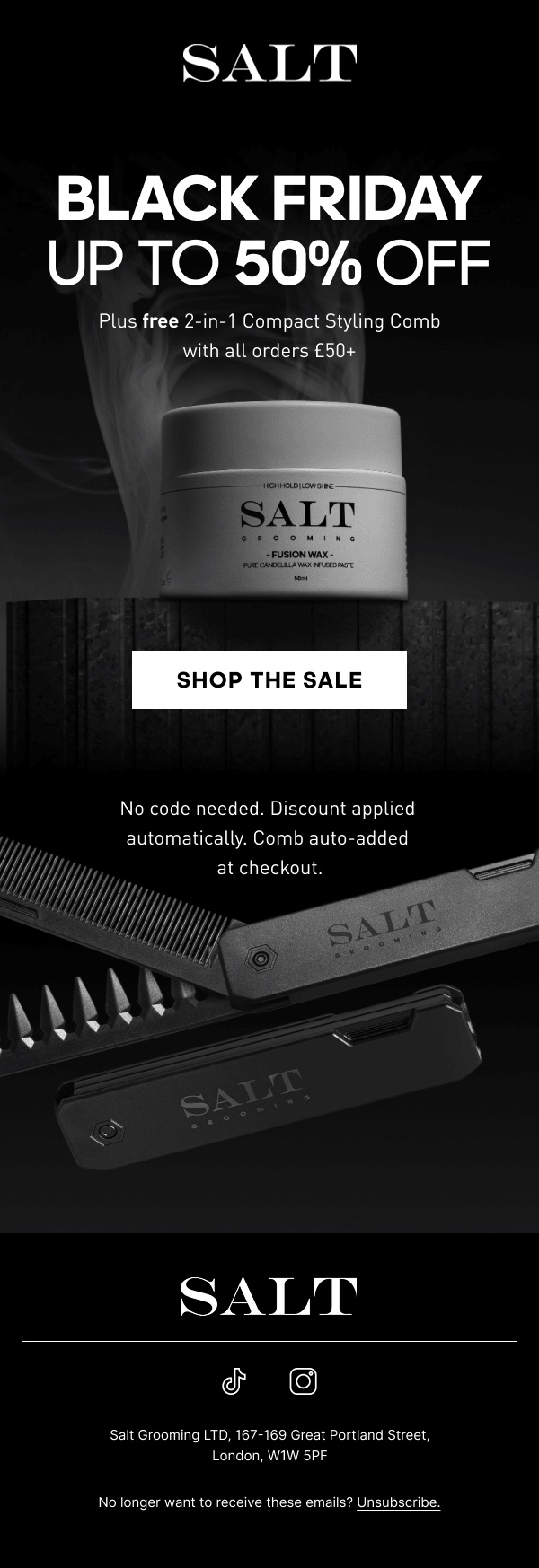
Every examples gallery on the internet shows you the creative and hides the outcome. Here is the opposite: real Black Friday sends from Everboost client accounts last November, in calendar order, with the numbers they produced where we have them. Two honesty notes before the gallery. First, one brand below is a previous client whose account we no longer have access to, so its creatives appear without metrics rather than with invented ones. Second, and more important, read the numbers correctly: VIP and early-access sends will almost always show higher click rates and revenue per recipient, because they go to smaller, higher-intent audiences. That does not make them “better” emails; the metrics are partly a product of the audience. Full-list announcement sends will almost always show lower rates while driving higher absolute clicks and revenue, and absolute revenue is what you should optimise for. Chasing the prettiest click rate just means shrinking your audience.
Scroll the gallery sideways; each email scrolls vertically inside its frame.







What about SMS on Black Friday?
More than the cautious advice suggests. BFCM is the one window where SMS earns aggressive use, precisely because inboxes are buried: on peak days, one to two texts a day is workable for a prepared brand, attached to the moments that are genuinely time-sensitive: early access opening, the public launch, mid-sale flashes, Black Friday, Cyber Monday, and final hours. Cast wide rather than narrow, with the exclusions doing the protecting: suppress anyone who has received ten or more texts all-time and never clicked (they are telling you something), dropped and invalid numbers, and recent purchasers, and add the de-duplication rule that saves both money and goodwill: if they clicked the email version, skip the text. Then treat SMS signals exactly like email signals: monitor opt-outs and complaints daily, and taper when they spike. UK brands: per-segment pricing means every one of those exclusions is worth actual money, not just deliverability hygiene.
How do you protect deliverability before the peak?
Sender reputation is the multiplier on every other decision in this playbook, and it moves on a lag, which is why the calendar starts with six unglamorous weeks. The work: purge the chronically disengaged (many sends, no clicks, no site activity: they are deliverability ballast, and removing them is what makes November’s full-list moments safe), suppress hard bounces, repeat soft-bouncers, spam complainers and spam traps permanently, verify SPF, DKIM and DMARC, watch complaints against Gmail and Yahoo’s 0.3% enforcement threshold in Postmaster Tools, and build cadence consistency so November’s volume is a continuation, not a shock.
Then bank positive signals on purpose. Two tactics do this better than anything else in the pre-season: a click-through early-access waiting list (every click is a positive signal logged before your volume ramps) and a reply-to-join early access email, because replies are the strongest engagement signal a subscriber can send and almost nobody asks for them. Mix plain-text sends into the warm-up for the same reason. We have rebuilt client sender scores from the 50s into the 90s, and the payoff concentrates at exactly this time of year: strong reputation is the difference between your launch email landing in front of your list on the most valuable morning of the year and landing in spam alongside everyone else’s.
What should your flows do during BFCM?
Most brands either forget their flows entirely or switch them off in a panic about conflicting offers. Both leak money. The playbook: swap, compress, align.
Swap, do not rebuild. Clone your existing flows into BFCM versions per phase (early access, Black Friday, Cyber Monday): update the offer, the hero and the code; strip anything that contradicts the live sale. An evergreen welcome flow offering 10% while your site says 30 is a margin leak, a customer-service ticket generator, and a trust problem, all at once.
Compress the timing. Evergreen flow delays are built for quiet weeks, and during a sale they fire after the moment has passed. First abandonment touches should land within 15 to 45 minutes, whole flows should complete within 48 hours, and one to three emails per flow is plenty while campaigns are running daily. Put the offer above the fold in every flow email; a plain-text founder-voice second touch reliably outperforms in a weekend of shouting graphics.
Keep capture and post-purchase aggressive. Never turn popups off during your highest traffic of the year; swap them to offer-announcement mode (well-executed sale popups convert at multiples of the evergreen rate, and people opt in so they do not miss the drop). And use the post-purchase moment: a BFCM buyer minutes after checkout is the warmest they will ever be, and a same-session add-on or second-order nudge inside the sale window is the cheapest revenue of the whole quarter. Exclude those recent buyers from further escalation sends, then bring them back for the final days.
How should subscription brands play BFCM?
Carefully, because the obvious move (discount the subscription sitewide) converts your most committed customers onto a permanently lower price to solve a weekend acquisition problem. The constructions that work instead: lead early access with your best subscription offer of the year, before the sitewide noise starts; add a gift or bonus product to subscriber orders rather than cutting the recurring price; and run prepaid gift subscriptions as the acquisition offer.
Two underused plays for brands with bigger catalogues. First, steep one-time add-ons for active subscribers: let the collagen subscriber add a different product to their next order at a depth steeper than anything advertised on the site. It rewards your best customers invisibly, lifts order value, and seeds cross-product routines without touching the public offer. Second, volume upgrades: a steeper discount to move a subscriber from a 30-day to a 90-day supply. You trade discount depth for commitment length, and the reorder clock (and the number of churn decisions per year) moves in your favour.
And design November’s acquisition offer with February in mind: our cancellation-data analysis found most subscription cancellations happen by the third order, and discount-recruited cohorts churn worse, so the BFCM offer construction is quietly a retention decision. The full numbers are in our DTC subscription churn benchmarks, and the platform mechanics in our subscription app guide.
What happens after Cyber Monday?
The window most guides end at is where several of the best plays live.
The quiet extension (1-2 December). Competitors stop sending Monday night; inboxes empty; you extend. The sharpest version reserves the strongest offer of the entire sale for engaged profiles who never purchased: they have told you the headline offer was not enough, and they are the only audience for whom a deeper number is news. Use it for marquee events only; a brand that extends everything trains its list to ignore every deadline it ever sets.
The gifting pivot (early December). Reframe from deals to gifts: curated sets and bundles, urgency built on real shipping cutoffs rather than manufactured countdowns, a last-chance send about 24 hours before the final shipping date, and gift cards as the honest stopgap for the shoppers who missed it.
The re-market inside the window. BFCM buyers buy twice more often than brands expect: give them a 48-hour grace, then bring them back for the later phases and the gifting window. A meaningful share of November first-timers can be back within weeks if you ask.
Then the freeze. After Christmas, your list is genuinely fatigued. Run four to five weeks of value-only content into late January, and resist the January discount reflex (health, fitness and supplement brands are the honest exception: a new-year window is category-native). The brands that respect the cooldown re-enter February with their engagement intact; the ones that keep pushing spend Q1 paying November’s deliverability bill.
What separates the brands that win BFCM?
Not depth, and not creative genius on the day. Across our client base the winners share three decisions made early: they started list and deliverability work in September so they could send wide and hard in November with signals to prove they had earned it, they kept the hero offer simple while gating access and depth by segment, and they treated the weekend as the start of a retention story rather than the end of an acquisition one, because the January question that matters is how many November buyers came back. If you want your BFCM plan pressure-tested against what is actually working across DTC brands this year, book a call, and bring your current offer construction: it is usually the first thing we would change, and the cheapest.
Frequently asked questions
When should you send Black Friday emails?
Earlier than BFCM week. For 2026: no-discount warm-up content through the first week of November, early access for VIPs, subscribers and your early-access list around 12 to 14 November, public launch in the week of 16 November, escalation into Black Friday itself (27 November), a distinct Cyber Monday offer on 30 November, and a quiet extension into 1 and 2 December. Consumers now expect and spend BFCM budgets from mid-November, so waiting for the week itself means arriving after wallets are lighter. The other half of the answer: the send window really starts in October, because list cleaning, cadence consistency and deliverability repair decide more November revenue than any individual send time.
When do Black Friday sales actually start now?
Mid-November for most serious DTC brands, with a meaningful minority launching on 1 November and outliers even earlier. The creep is real: first it was a Friday, then a weekend, then a week, now commonly a month. It is also self-limiting: a list that has seen discounts since 1 November is numb by the 27th, and practitioners who pushed earliest in 2025 reported diminishing returns. Our advice is to capitalise on the creep without leading it: launch publicly in the week of 16 November, use early access to pull revenue forward before that, and never starve your best offer away from the cultural peak, because most shoppers still buy across the Black Friday to Cyber Monday window itself.
How many Black Friday emails should you send?
As many as your engagement signals support, which for most prepared brands is more than feels comfortable: daily sends through the sale, rising to two or three on Black Friday and Cyber Monday themselves. Fixed caps are the wrong frame. Watch opens, clicks, unsubscribes and spam complaints daily: while positive signals hold and negatives stay quiet, keep ramping, because every competitor is ramping and a quiet sender gets drowned out; when negatives spike, pull back. Two guardrails: never double your volume overnight (ramp into it with a consistent cadence from early November), and give every send a distinct job rather than repeating the same email.
What is the 3 email rule?
The rule of thumb that any promotion needs at least three sends: an announcement, a reminder, and a last-chance email, because a large share of total promotion revenue reliably arrives in the final urgency send. It is a floor, not a ceiling: for a promotion as large as BFCM, three emails is far too few for engaged subscribers, but the underlying logic holds, and the last-chance email is consistently among the highest-revenue sends of the entire sequence. If you send it, mean it: a deadline that quietly extends every time trains your list to ignore your deadlines.
What discount should you offer on Black Friday?
A hero offer simple enough to understand in one second and competitive enough to survive comparison shopping, then architecture around it. Going too shallow is a real risk: your customers will be holding offers from competitors all weekend. But depth is not the only lever: gate access (VIPs and subscribers get the same offer earlier, never a weaker one), gate segment-level depth privately (your deepest codes go to never-purchased and lapsed segments that need convincing, your lightest to recent full-price loyalists who convert anyway), and rotate mid-sale layers like gifts-with-purchase and short flashes to create urgency without permanent markdown. In our client work, gated and rotating constructions have grown revenue while discounting roughly a third less per order.
When should you start planning your Black Friday campaign?
Six to eight weeks out at minimum for the campaign itself, which for Black Friday 2026 means late September to early October. Deliverability and list work should start even earlier, because sender reputation moves on a lag, and the pre-BFCM clean (removing chronically disengaged profiles who have received many sends with no clicks and no site activity) is what makes full-list sends during the sale safe. List growth also compounds ahead of the peak: every subscriber captured in October is a near-free BFCM recipient in November.
How do you announce a Black Friday sale?
In stages, not in one email. Tease the schedule before the offer (telling people when to check their inbox conditions engagement), open early access to VIPs and subscribers with explicit recognition that they are getting it first, then launch publicly with the offer stated plainly in the subject line and the hero, one CTA, and no clutter. On the most crowded inbox days of the year, clarity beats cleverness. One underused tactic: make early access something people reply to or click to join, because replies and clicks are exactly the signals inbox providers weigh when your volume ramps.
Should you send an email on Thanksgiving itself?
For most DTC brands yes, but a considered one: Thanksgiving (26 November 2026) sits between early access and the public peak, and inboxes are quieter than Black Friday itself. A warm, low-pressure send to engaged segments performs well and stakes your claim before the Friday avalanche. Skip the unengaged list entirely that day; the deliverability risk is not worth it.
What about SMS on Black Friday?
Send more than the cautious advice suggests: SMS earns its keep during BFCM precisely because inboxes are buried, and on peak days one to two texts a day is workable for prepared brands. Cast wide with the right exclusions rather than narrow by default: suppress subscribers who have received ten or more texts and never clicked (they will not start now), dropped and invalid numbers, and recent purchasers. Add the de-duplication rule: if someone clicked the email version, skip the text. Then monitor opt-outs and complaints daily exactly as you do for email, and taper when they spike. In the UK, per-segment pricing makes those exclusions worth actual money.
How do you protect deliverability before BFCM?
Start six to eight weeks out: purge chronically disengaged profiles (many sends, zero clicks, zero site activity), suppress hard bounces, repeat soft-bouncers, spam complainers and known spam traps permanently, fix authentication (SPF, DKIM, DMARC), keep complaints under Gmail and Yahoo's 0.3% threshold, and build cadence consistency so November's volume is a ramp, not a shock. Bank positive signals deliberately: a click-through early-access waiting list and a reply-to-join early access email generate exactly the engagement inbox providers weigh. We have rebuilt client sender scores from the 50s into the 90s, and the payoff concentrates at BFCM, when weak reputation turns your biggest sends of the year into spam-folder events.
How should subscription brands handle Black Friday?
Do not discount the recurring subscription price sitewide, or you convert your most committed customers onto a permanently lower price. Better constructions: lead early access with your best subscription offer before the sitewide noise, add a gift or bonus product to subscriber orders, and for brands with bigger catalogues, give active subscribers one-time add-on offers steeper than anything advertised publicly (a collagen subscriber adds a second supplement to their next order at a depth the site never shows) and volume upgrades (a steeper discount to move from a 30-day to a 90-day supply, which lengthens the reorder clock). Discount-recruited subscribers churn measurably worse, so November's acquisition offer decides February's churn curve.
What should you do after Cyber Monday?
Three things most brands skip. First, a quiet extension into the Tuesday and Wednesday, ideally with your strongest offer reserved for engaged profiles who never purchased, while competitors go silent; keep this play for marquee events only, because a brand that extends every promotion trains its list to ignore every deadline. Second, pivot to gifting: December offers framed around gifts, urgency built on real shipping cutoffs, and gift cards as the post-cutoff stopgap. Third, respect the fatigue: after Christmas, run a four-to-five-week promotional freeze with value content only (health and supplement brands are the exception, with a January new-year window), and re-market your new BFCM buyers inside the sale window itself after a short grace period, because a meaningful share will buy twice.
Is Black Friday worth it for premium brands that never discount?
Yes, without discounting. The no-markdown constructions work precisely because they are rare in November: gift-with-purchase, limited products or bundles, early access to new releases, extended guarantees or free upgrades, and donation-linked offers. Your list will be shopping that weekend regardless; the question is whether you show up with something worth opening. A premium brand sending nothing on BFCM weekend is not protecting its brand, it is donating attention to competitors.